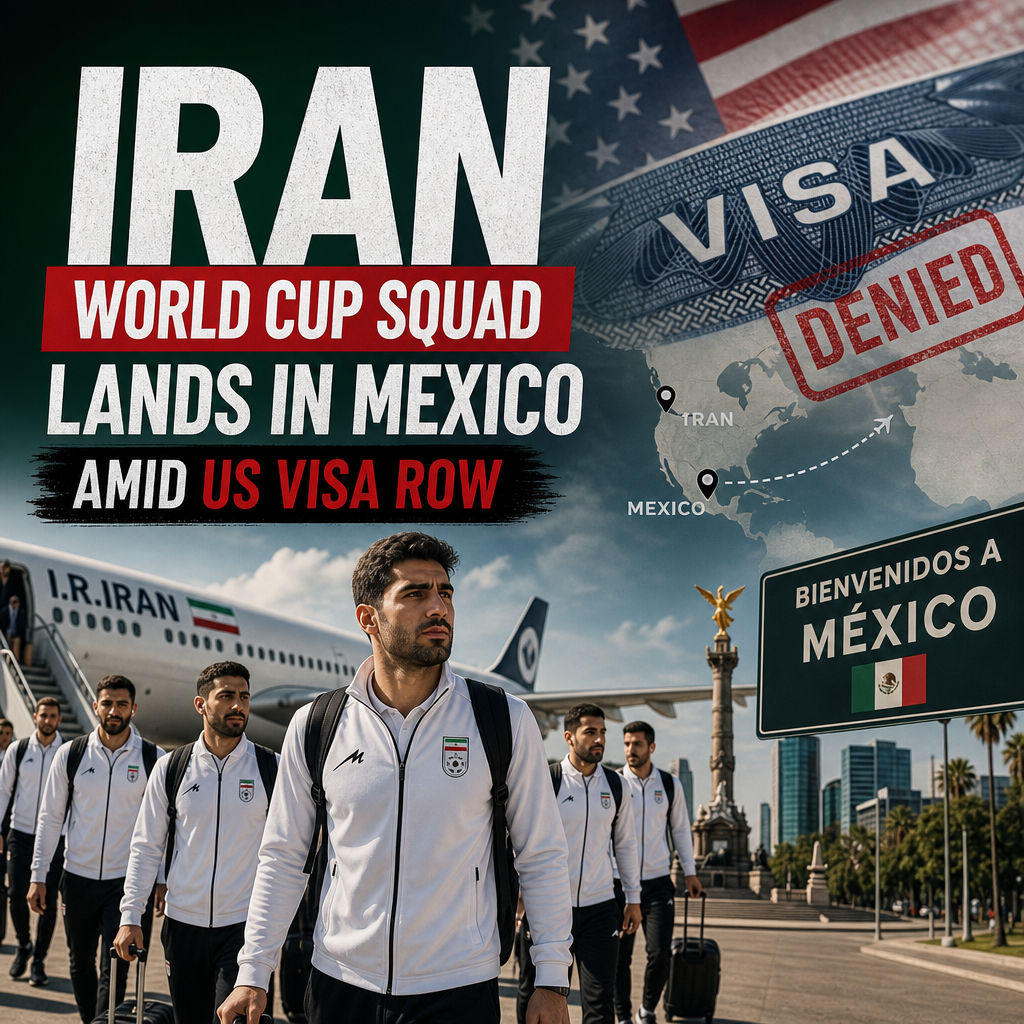
Iran World Cup Squad Lands in Mexico Amid US Visa Row


Iran World Cup Squad arriving in Mexico has become more than a routine pre-tournament travel story, turning into a reminder that football often collides with geopolitics in ways that are hard to ignore.
The team’s arrival in Mexico, reported amid an unresolved US visa dispute, highlights the awkward position Iran finds itself in as the World Cup build-up unfolds. On paper, this is a sporting matter: a national team preparing for the biggest stage in football. In practice, it is also about diplomacy, border controls, security concerns, and the long shadow of strained relations between Tehran and Washington.



What makes this case notable is not simply that a squad has landed in another country to prepare. It is that the move happened against the backdrop of a visa row that underscores how international sport is rarely insulated from international politics. Depending on the source and the lens through which the story is viewed, the situation can be read as a logistical workaround, a political signal, or a symptom of deeper mistrust.
Why the Iran World Cup Squad is preparing in Mexico
The basic sporting logic is straightforward. Mexico provides a practical base for training and acclimatisation, especially as the tournament approaches and travel plans become increasingly sensitive. Teams often seek neutral or convenient locations to finalize preparations, and in this case Mexico appears to offer a workable solution while the visa issue remains unresolved.




But the location also matters politically. By arriving in Mexico rather than proceeding directly through the United States, Iran’s players and staff are effectively operating around an obstacle that has little to do with footballing merit. That is what gives the story its weight.
Across coverage from different outlets, there is a common recognition that the issue extends beyond a single team. Visa disputes involving athletes can quickly become symbolic, especially when they involve countries with tense diplomatic histories. Some reporting frames the row as an administrative challenge; others stress how such disputes can be experienced as a form of exclusion, particularly when athletes are left uncertain about whether they will be allowed to travel and compete as planned.
A familiar clash between sport and state power
Football’s global appeal rests on the idea that the game can bring people and nations together. Yet that ideal often meets the hard reality of state power. Visas are granted or withheld by governments, not sports federations, and in politically sensitive cases the process can become unpredictable.
That is why the Iran World Cup Squad situation has drawn attention beyond the sports pages. It raises a broader question: should elite athletes, who are representing their country in a regulated international competition, be caught in the middle of political disagreements that they did not create?
There is no simple answer. Governments argue that border and visa decisions are sovereign matters, shaped by security vetting and domestic law. Critics counter that when sporting travel becomes entangled in political friction, the athletes pay the price. Both positions can be true at once, which is what makes the issue so difficult to resolve neatly.
What different sources suggest about the dispute
The available reporting points to at least three overlapping viewpoints.
– The sporting view: Iran is doing what teams do before major tournaments — finding a practical training base and keeping preparations on track.
– The political view: The visa row reflects wider tensions between Iran and the United States, making the team’s travel circumstances a matter of diplomacy as much as sport.
– The human view: Players and staff are left to cope with uncertainty that can disrupt planning, morale, and competitive readiness.
That mix of perspectives is important because it prevents the story from becoming one-dimensional. If the issue were only about logistics, it would likely have attracted little attention. If it were only about politics, the sporting implications might be overlooked. In reality, it is both.
Some commentary around international football tends to treat such disputes as inevitable friction in a world still divided by national interests. Other coverage is more critical, suggesting that major tournaments should have stronger mechanisms to protect teams from last-minute administrative or political barriers. The tension between those views is unresolved, and the Iran case fits squarely within that ambiguity.
What this means for the tournament
The immediate question is whether the visa row affects Iran’s ability to prepare properly and arrive at the tournament in a settled state. Even when a team secures a temporary workaround, the disruption itself can matter. Training schedules, recovery plans, and media commitments are all easier to manage when travel is predictable.
There is also a reputational dimension. For the tournament organizers and host countries, a visa dispute involving a qualified team is not a good look. It invites criticism about fairness and raises concerns about whether sport is being compromised by politics. At the same time, any official response has to balance practical access with legitimate border and security procedures.
For fans, the story may prompt a more uncomfortable realization: international football still depends on a world order in which some teams move freely and others do not. That unevenness does not always make headlines, but it shapes the experience of the competition all the same.
The bigger picture
The Iran World Cup Squad’s landing in Mexico is not just a transit note before kickoff. It is a snapshot of how modern sport operates inside a tangled global system, where national pride, administrative rules, and geopolitical rivalry can all influence the path to the pitch.
The most balanced reading of the situation is that no single party fully controls the outcome. Iran can manage its preparations, Mexico can host, and the United States can enforce its own visa rules — but the players still end up caught in the middle. That is why this story resonates. It is not only about who gets to travel, but about what happens when the universal language of football still has to speak through the barriers of politics.